
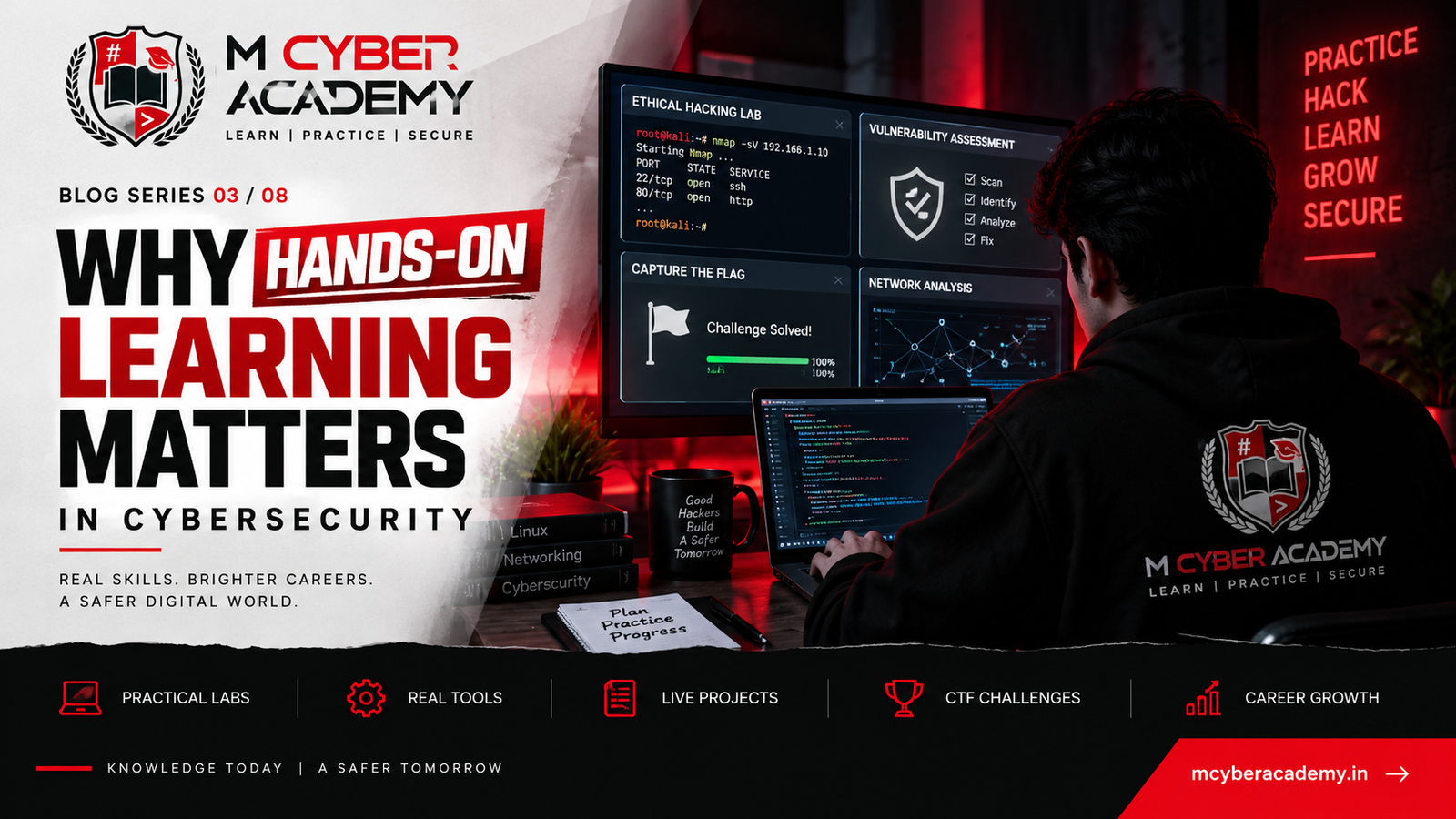
Why Hands-On Learning Matters in Cybersecurity
Cybersecurity is not a field you master by reading alone. Discover why
practical training, cybersecurity labs, real-world scenarios and
hands-on projects are essential for building skills that actually work.
You can read about a vulnerability, memorize security terminology and
watch hours of cybersecurity tutorials. But when you have to investigate
a suspicious connection, analyze a system, test an application or solve
a security challenge yourself, the learning becomes different.
Cybersecurity is a practical field, and practical skills require practice.
Cybersecurity Is a Practical Skill
Cybersecurity professionals work with systems, networks, applications,
devices, logs, security tools and constantly changing threats. Because
of this, understanding a concept theoretically is only one part of
becoming capable of applying it.
For example, knowing what a network scan is does not automatically mean
you can interpret the results of one. Understanding what a web
vulnerability is does not mean you will immediately know how to
identify it during a security assessment.
This is where hands-on cybersecurity training becomes
important. Practical learning gives students the opportunity to move
from understanding a concept to actually applying it.
Knowledge tells you what something is.
Hands-on practice helps you understand how to work with it.
Why Theory Alone Isn’t Enough
Theory gives you the foundation. It explains concepts, terminology,
technologies and security principles. But cybersecurity also requires
problem-solving, investigation and technical decision-making.
01. Learn Linux
Reading Linux commands is useful, but working directly in a Linux
environment teaches you how commands, permissions, files and
processes behave.
02. Practice Web Security
Studying web vulnerabilities becomes more meaningful when you can
safely investigate them inside a controlled cybersecurity lab.
03. Understand Networking
Networking concepts become easier to connect when you work with
traffic, services, ports and network analysis in practical
exercises.
04. Investigate Security Events
Security monitoring and incident response require learners to
interpret information, identify unusual activity and decide what
should be investigated further.
What Does Hands-On Cybersecurity Learning Look Like?
Practical cybersecurity learning does not mean simply running tools.
Good training creates a controlled environment where learners can
understand a problem, test a solution, analyze the result and learn
from mistakes.
Learn
Practice
Challenge
Build
Analyze
This can include Linux labs, networking exercises, web security
labs, vulnerability assessment, penetration-testing environments,
digital forensics exercises, Capture The Flag challenges and
cybersecurity projects.
Practice should be controlled and authorized.
Cybersecurity learners should perform testing only in environments
where they have explicit permission, such as training labs, CTF
platforms, sandbox environments or systems specifically provided for
security testing.
Skills You Build Through Practice
One of the biggest benefits of practical cybersecurity training is that
it develops skills that are difficult to build through passive learning
alone.
Problem Solving
Networking
Linux
Security Tools
Web Security
Threat Analysis
Documentation
Technical Thinking
Vulnerability Assessment
Incident Investigation
Practice also teaches something that is easy to underestimate:
how to deal with problems that do not have an obvious answer.
A lab may fail, a command may produce an unexpected result, or a
vulnerability may require several steps to understand. Working through
these situations develops technical independence.
Don’t aim to memorize every cybersecurity tool.
Aim to understand what problem a tool solves, how to use it,
how to interpret its output and what to do next.
From Practice to Cybersecurity Career
Hands-on experience can also help learners create evidence of what they
have learned. Instead of simply saying that you studied cybersecurity,
you can document the labs you completed, projects you built, challenges
you solved and security concepts you applied.
A practical portfolio might include a documented security assessment
performed in a legal lab environment, a vulnerability analysis,
cybersecurity project, CTF write-up, network investigation or a
technical report explaining what you discovered and how you approached
the problem.
This kind of work can help learners understand their own strengths and
identify areas where they need more practice. It can also give them
concrete technical experiences to discuss when applying for
cybersecurity internships, projects or entry-level opportunities.
At M Cyber Academy
The goal of practical cybersecurity learning is to help learners move
beyond theory and work with cybersecurity concepts through
hands-on labs, practical exercises, projects and security
challenges in controlled learning environments.
Frequently Asked Questions
Why is hands-on learning important in cybersecurity?
Hands-on learning allows students to apply cybersecurity concepts
in controlled environments. It helps develop technical skills,
problem-solving ability, tool familiarity and practical understanding
of security workflows.
Can I learn cybersecurity through theory alone?
Theory is important for building a strong foundation, but practical
experience is equally important. Working with labs, projects and
controlled security exercises helps turn theoretical knowledge into
usable skills.
What cybersecurity labs should beginners practice?
Beginners can start with networking, Linux, web security,
vulnerability assessment and basic security investigation labs.
CTF platforms and authorized sandbox environments can also provide
useful practice.
Do cybersecurity projects help build a portfolio?
Yes. Well-documented projects can demonstrate how you approached a
technical problem, what tools you used, what you discovered and
what you learned. Projects should always be performed in
authorized environments.
How can I start practical cybersecurity training?
Start with fundamentals such as networking, Linux and operating
systems, then gradually move into security labs, ethical hacking,
web security, vulnerability assessment and other areas based on
your interests.
Learn Cybersecurity by Doing
Build your cybersecurity foundation through practical learning,
hands-on labs, security challenges and real technical exercises with
M Cyber Academy.