
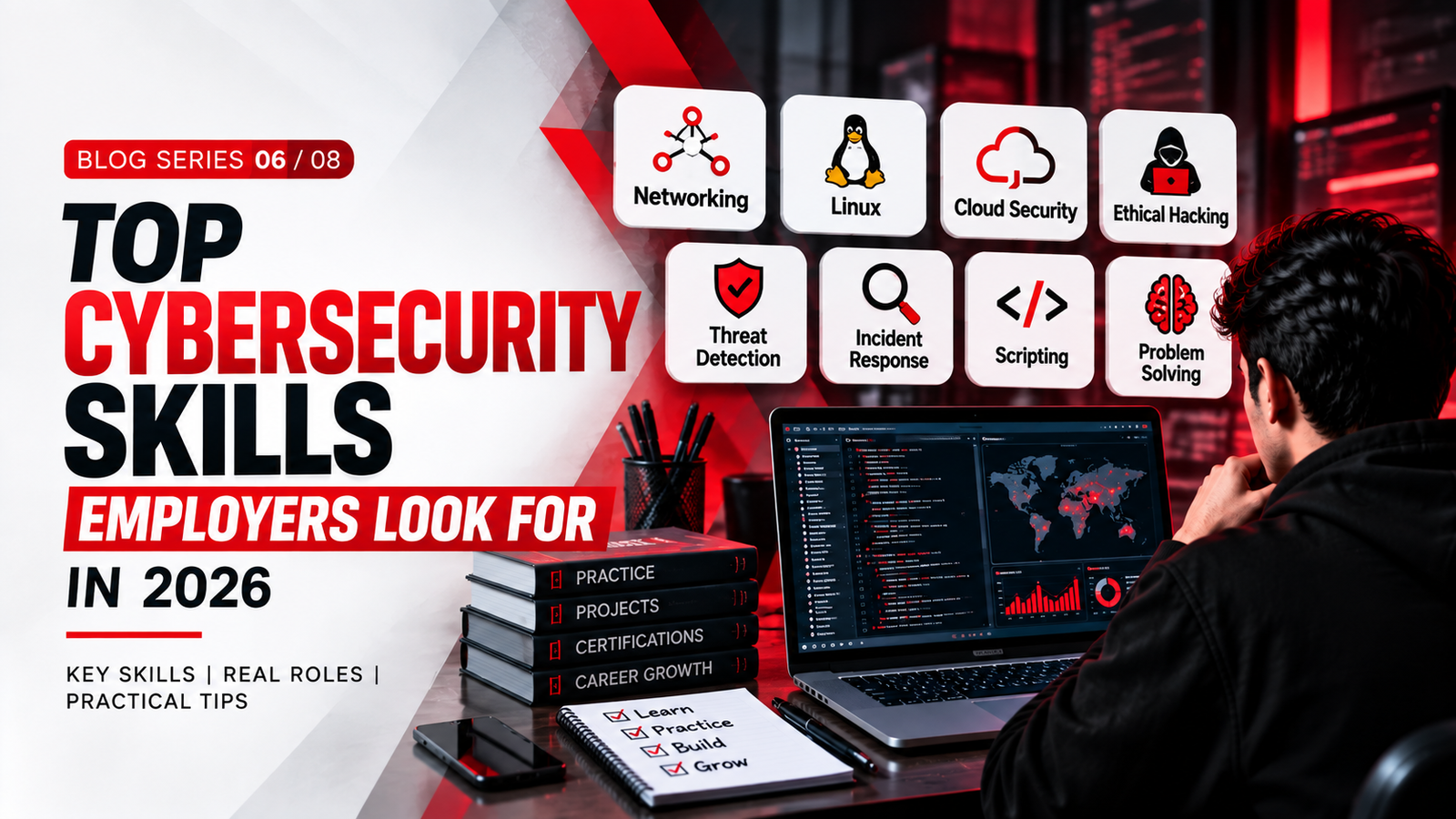
Top Cybersecurity Skills Employers Look For in 2026
Want to build a career in cybersecurity? Discover the technical skills,
practical experience, and professional abilities that can help you prepare
for real-world cybersecurity roles.
01. What Do Employers Look for in Cybersecurity Candidates?
Cybersecurity is not just about knowing how hackers attack systems.
It is about understanding how technology works, identifying security
weaknesses, protecting information, and responding to potential threats.
That is why employers look for a combination of technical knowledge,
practical skills, and problem-solving ability.
Whether you want to become an ethical hacker, security analyst, penetration
tester, or cloud security professional, your skills should match the
responsibilities of the role you are targeting.
What employers may evaluate
- Technical fundamentals: Your understanding of networks, operating systems, and security concepts.
- Practical experience: Your ability to apply knowledge in labs, projects, and authorized security exercises.
- Analytical thinking: How you investigate unusual activity and identify possible causes.
- Communication: How clearly you explain security issues and document your findings.
- Continuous learning: Your willingness to keep up with changing tools, threats, and technologies.
Remember: A certificate can demonstrate learning, but practical projects and the ability to explain your work can help employers understand what you can actually do.
02. Technical Skills Every Cybersecurity Professional Should Know
Strong cybersecurity skills begin with a solid understanding of technology.
You do not need to master every tool at once. Start with the fundamentals,
then build skills based on the cybersecurity career path you want to pursue.
Networking Fundamentals
Understand IP addresses, ports, DNS, HTTP and HTTPS, TCP/IP,
routing, firewalls, and common network protocols. Networking knowledge
helps you understand how systems communicate and where security risks
may appear.
Linux and Windows
Learn command-line basics, file permissions, user accounts, processes,
services, logs, and system configuration. These skills help you
investigate systems, troubleshoot issues, and understand security controls.
Security Fundamentals
Understand authentication, authorization, encryption, access control,
vulnerabilities, risk management, and security policies. These concepts
provide the foundation for almost every cybersecurity specialization.
Scripting and Basic Programming
Learn the basics of Python, Bash, or PowerShell. Scripting can help
automate repetitive tasks, process logs, analyze data, and support
security testing. The amount of coding required depends on the role.
Threat Detection and Incident Response
Learn how to review logs, recognize suspicious activity, investigate
alerts, and understand incident response processes. Familiarity with
SIEM concepts and endpoint monitoring can be useful for security
operations roles.
Ethical Hacking and Vulnerability Assessment
Understand how to identify security weaknesses through authorized
testing. Learn vulnerability assessment, web security basics,
reconnaissance, testing methodology, and responsible reporting.
Cloud Security
Understand cloud environments, identity and access management,
permissions, data protection, network security, and secure configuration.
Knowledge of platforms such as AWS, Microsoft Azure, or Google Cloud
can support cloud-focused security roles.
Identity and Access Management
Learn how user identities, permissions, multi-factor authentication,
and access policies help protect systems. These concepts are important
for managing who can access sensitive resources.
Learning tip: Build a strong foundation in networking, operating systems, and security fundamentals before moving into advanced specializations.
03. Hands-On Skills That Make Your Profile Stand Out
Reading about cybersecurity is a useful starting point, but practical
experience helps you understand how security concepts work in real
environments. Employers may ask you to explain a project, walk through
a technical problem, or describe how you investigated a security issue.
Practical skills worth developing
1. Cybersecurity Labs
Practice in safe, authorized lab environments. Use virtual machines,
intentionally vulnerable applications, and guided exercises to understand
how security weaknesses can be identified and addressed.
2. Log Analysis and Threat Investigation
Work with sample system and security logs. Learn to identify unusual
login attempts, unexpected processes, suspicious network activity,
and other indicators that may require investigation.
3. Penetration Testing Practice
Learn the stages of an authorized security assessment, including
information gathering, vulnerability identification, controlled testing,
evidence collection, and reporting. Always practice within systems
you own or have explicit permission to test.
4. Security Projects
Build small projects that demonstrate your skills. Examples include
a basic log analyzer, a secure network design, a vulnerability
assessment report for a lab environment, or a script that automates
a routine security task.
5. Documentation and Reporting
Practice writing clear reports that explain the issue, its potential
impact, supporting evidence, and recommended remediation. Good
documentation makes technical findings easier for teams to understand
and act on.
Examples of projects for your portfolio
- Set up a small virtual lab and document its security configuration.
- Analyze sample authentication logs and summarize suspicious patterns.
- Complete an authorized web application security lab and write a report.
- Create a Python script to organize or analyze sample security data.
- Design a secure network diagram with access controls and segmentation.
Portfolio tip: For every project, explain the objective, tools used, steps followed, what you learned, and how you would improve the solution. Never publish confidential data or sensitive details from a real organization.
04. Soft Skills That Matter in Cybersecurity Jobs
Cybersecurity professionals work with technical teams, management,
business departments, and sometimes customers. Technical knowledge
is important, but the ability to communicate findings and work with
others also matters.
Analytical Thinking
Security problems do not always have obvious answers. Learn to examine
evidence, compare possible explanations, identify patterns, and reach
conclusions based on what the data actually shows.
Communication
Practice explaining technical issues in simple language. A good
cybersecurity professional should be able to describe what happened,
why it matters, and what action may be needed.
Attention to Detail
Small details in logs, configurations, permissions, or reports can
make a difference. Develop the habit of checking evidence carefully
and documenting your observations accurately.
Teamwork and Collaboration
Cybersecurity often involves working with IT, development, compliance,
and operations teams. Learn to share information, ask clear questions,
and coordinate your work with others.
Adaptability and Continuous Learning
Tools, technologies, and attack methods change over time. Stay curious,
review new concepts, practice regularly, and be willing to learn from
mistakes and feedback.
05. How to Build the Skills Employers Want
If you are a beginner, you do not need to learn everything in one day.
A structured learning plan can help you build confidence and track your
progress. Follow these steps to develop skills for your cybersecurity career.
-
Build Your Fundamentals
Learn networking, operating systems, basic security concepts, and
command-line skills. These topics will support your understanding
of more advanced security areas. -
Choose a Career Direction
Explore roles such as security analyst, ethical hacker, penetration
tester, cloud security analyst, or incident responder. Review the
skills and responsibilities associated with the roles that interest you. -
Practice in Authorized Labs
Apply what you learn through hands-on exercises, guided labs,
and controlled environments. Focus on understanding the process,
not just completing the task. -
Build Projects and Document Your Work
Create a portfolio with project summaries, lab reports, scripts,
diagrams, and lessons learned. Share only information that is safe
and appropriate to publish. -
Consider Relevant Certifications
Choose certifications that match your current knowledge and career
goals. A certification can help structure your learning, but it should
complement practical experience rather than replace it. -
Prepare for Interviews and Keep Improving
Practice explaining technical concepts, discussing your projects,
and solving basic security problems. Use feedback to identify what
you should learn next.
Cybersecurity roles and the skills they may require
Security Analyst
Networking, log analysis, threat detection, incident response,
security monitoring, and clear documentation.
Ethical Hacker / Penetration Tester
Networking, Linux, web security, vulnerability assessment,
authorized testing methodology, and technical reporting.
Cloud Security Professional
Cloud platforms, identity and access management, secure configuration,
network controls, and data protection.
Incident Response Professional
Log analysis, endpoint investigation, evidence handling,
incident documentation, and response procedures.
Career reminder: Job requirements vary by employer and experience level. Review actual job descriptions for the roles you want, then use them to guide your learning plan.
06. Frequently Asked Questions
1. What cybersecurity skills do employers look for in freshers?
Employers may look for networking fundamentals, knowledge of Linux
and Windows, basic security concepts, problem-solving, communication,
and a willingness to learn. Hands-on labs, projects, and clear
documentation can help freshers demonstrate their abilities.
2. Is coding necessary for a cybersecurity career?
Not every cybersecurity role requires advanced coding. Basic scripting
in Python, Bash, or PowerShell can be useful for automation and
analysis. More technical roles, such as security engineering and
exploit development, may require deeper programming knowledge.
3. Can I get a cybersecurity job without experience?
Some entry-level roles are open to candidates with limited professional
experience, depending on the employer and role. Practical labs,
projects, internships, foundational knowledge, and relevant
certifications may help demonstrate your preparation.
4. Which technical skills should a beginner learn first?
Start with networking fundamentals, Linux and Windows basics,
security principles, and command-line skills. Then explore a
specialization such as security operations, ethical hacking,
or cloud security.
5. Are cybersecurity certifications enough to get a job?
A certification alone does not guarantee employment. Employers may
also consider practical skills, projects, communication, relevant
experience, and how well your knowledge matches the position.
6. How can I demonstrate cybersecurity skills on my resume?
Include relevant technical skills, certifications, lab experience,
projects, internships, and measurable outcomes where appropriate.
Add a portfolio or project repository if you have one, and clearly
explain your contribution to each project.
Build Skills. Practice More. Grow Your Career.
Start building your cybersecurity foundation with structured learning,
hands-on practice, and career-focused skill development.
Explore cybersecurity learning opportunities with M Cyber Academy.