
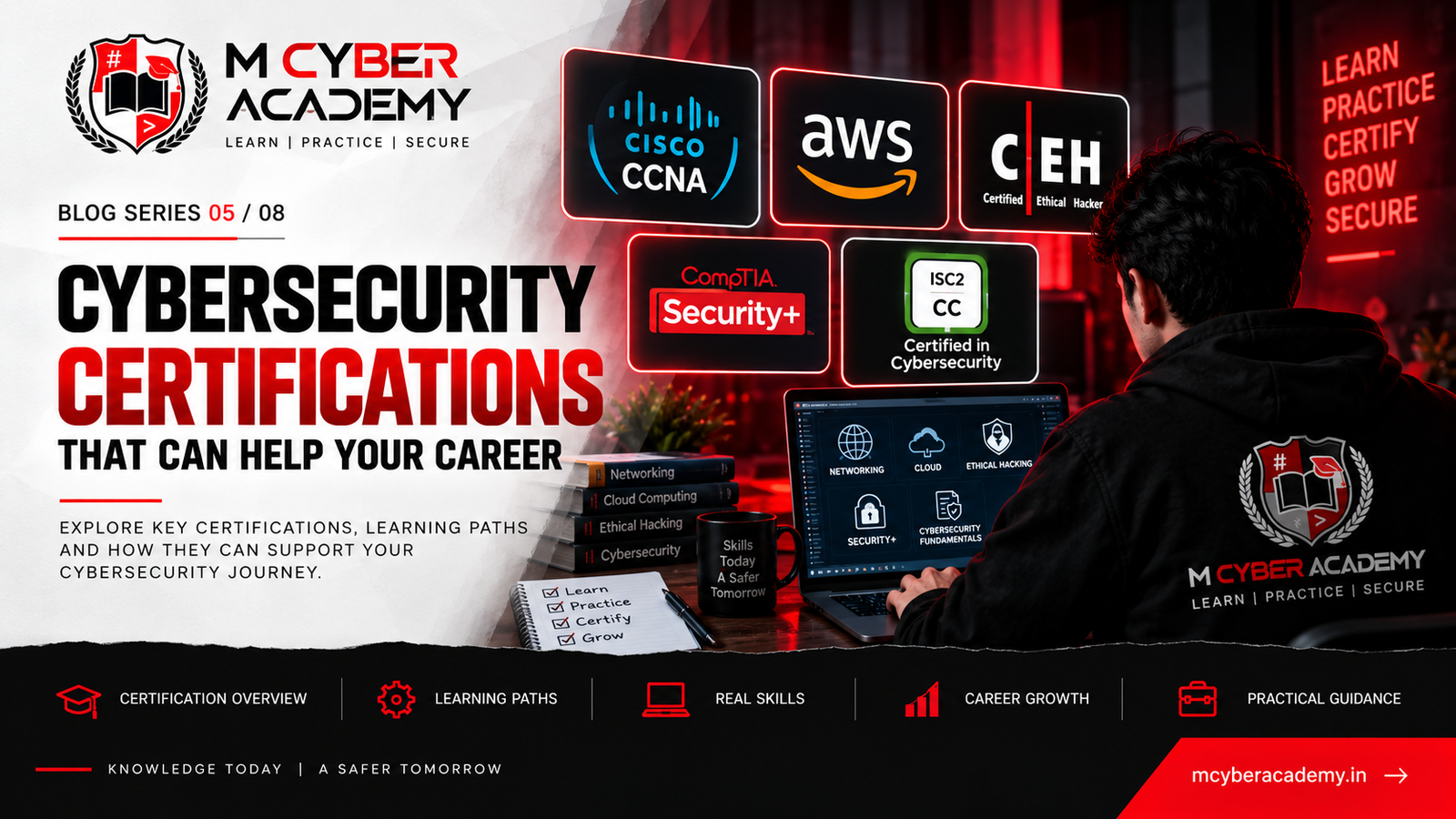
Cybersecurity Certifications
That Can Help Your Career
From cybersecurity fundamentals and networking to ethical hacking and
cloud security, explore certifications that can help you build and
demonstrate skills for different cybersecurity career paths.
A certification can show that you have studied a defined body of
knowledge and prepared for an assessment. But in cybersecurity,
certification works best alongside practical skills, projects
and hands-on experience.
The right certification depends on where you are starting and the area
of cybersecurity you want to explore.
Why Do Cybersecurity Certifications Matter?
Cybersecurity covers a wide range of areas, including networking,
security operations, ethical hacking, cloud security, digital forensics,
application security and incident response.
A certification can help structure your learning around a defined set
of topics and give you a credential that you can add to your resume or
professional profile.
However, a certificate should not be treated as a replacement for
technical practice. Employers and technical teams may also look at
projects, practical experience, problem-solving ability and
familiarity with security tools and technologies.
A certification can validate knowledge.
Practical work helps demonstrate how you apply that knowledge.
Certifications to Know for a Cybersecurity Career
There is no single certification path for everyone. The following
certifications cover different foundations and specializations, so the
right choice depends on your current knowledge and career direction.
ISC2 Certified in Cybersecurity (CC)
Designed as an entry-level cybersecurity credential. ISC2 states
that the CC does not require work experience and covers areas such
as security principles, access controls, network security and
security operations.
CompTIA Security+
A widely used cybersecurity certification focused on foundational
security knowledge. It can fit learners who want a broad
introduction to core cybersecurity concepts and practices.
Cisco CCNA
CCNA focuses on network fundamentals, network access, IP
connectivity, IP services, security fundamentals and automation.
Networking knowledge can provide an important foundation for
cybersecurity work.
Certified Ethical Hacker (CEH)
CEH focuses on ethical hacking concepts, attack techniques,
security tools and methodologies. The current program also includes
hands-on labs and practical elements.
AWS Certifications
AWS offers certifications at foundational, associate, professional
and specialty levels. Cloud knowledge is increasingly relevant to
cybersecurity professionals working with cloud infrastructure.
AWS Certified Security – Specialty
This specialty certification focuses specifically on securing AWS
workloads and architectures, including areas such as detection,
incident response, infrastructure security, IAM and data protection.
Important distinction:
CCNA is primarily a networking certification and AWS certifications
primarily validate cloud skills. They are included here because
networking and cloud technologies are closely connected to
modern cybersecurity work.
Match the Certification to Your Learning Path
Instead of collecting certifications randomly, think about the type of
technical work you want to explore. Your certification path can then
develop around that direction.
Cybersecurity Fundamentals
Start with foundational cybersecurity knowledge through credentials
such as ISC2 CC or Security+ and build your understanding of core
security concepts.
Networking
If you want to understand how networks communicate and how network
infrastructure works, CCNA can help build that technical foundation.
Ethical Hacking
Learners interested in offensive security can explore ethical
hacking training and certifications such as CEH alongside
authorized hands-on security labs.
Cloud & Cloud Security
Learners moving toward cloud environments can build AWS knowledge
and later explore security-focused cloud certifications based on
their experience.
Certification + Practical Skills
Preparing for an exam can help you understand a structured set of
concepts. The next step is learning how to apply those concepts.
Learn Fundamentals
Practice
Choose a Specialization
Prepare & Certify
Build Projects
For example, someone studying networking can combine certification
preparation with network labs. Someone learning ethical hacking can
practice in authorized labs and CTF environments. Someone studying
cloud security can work with cloud-based security configurations and
monitoring concepts.
Keep a record of your
projects, labs, CTF challenges, reports and practical work
so your learning is more than a list of certificates on a resume.
How to Start Your Certification Journey
If you are new to cybersecurity, start by understanding the basics
rather than immediately choosing an advanced certification. Networking,
operating systems, Linux, security concepts and basic troubleshooting
provide useful foundations.
Once you understand the fundamentals, choose a certification that
matches the area you want to explore. You can then combine exam
preparation with hands-on cybersecurity training, labs and
projects.
At M Cyber Academy
Learners can build cybersecurity foundations and explore areas such as
ethical hacking, penetration testing, digital forensics,
cybersecurity tools and practical security exercises alongside
their broader certification journey.
Frequently Asked Questions
Which cybersecurity certification should a beginner consider?
Beginners can explore entry-level credentials such as ISC2
Certified in Cybersecurity. The right starting point depends on
your existing IT knowledge, learning goals and preferred
specialization.
Is CCNA useful for a cybersecurity career?
CCNA is a networking certification rather than a dedicated
cybersecurity certification. Its coverage of network fundamentals,
IP connectivity, services and security fundamentals can help build
networking knowledge that is useful in cybersecurity.
Are AWS certifications useful in cybersecurity?
AWS certifications can be relevant when your cybersecurity work
involves cloud environments. AWS also offers the AWS Certified
Security – Specialty credential specifically focused on securing
AWS workloads and architectures.
Is a cybersecurity certification enough to get a job?
A certification demonstrates knowledge in a defined area, but
cybersecurity roles can also require practical skills, projects,
technical experience and problem-solving ability. Building
hands-on experience alongside certification preparation can give
you more evidence of your skills.
Should I get multiple cybersecurity certifications?
More certifications are not automatically better. It is generally
more useful to choose credentials that match your learning stage
and career direction, then build practical experience around the
skills they cover.
Learn. Practice. Certify.
Build your cybersecurity foundation with practical learning in ethical
hacking, digital forensics, security tools and other cybersecurity
domains with M Cyber Academy.