
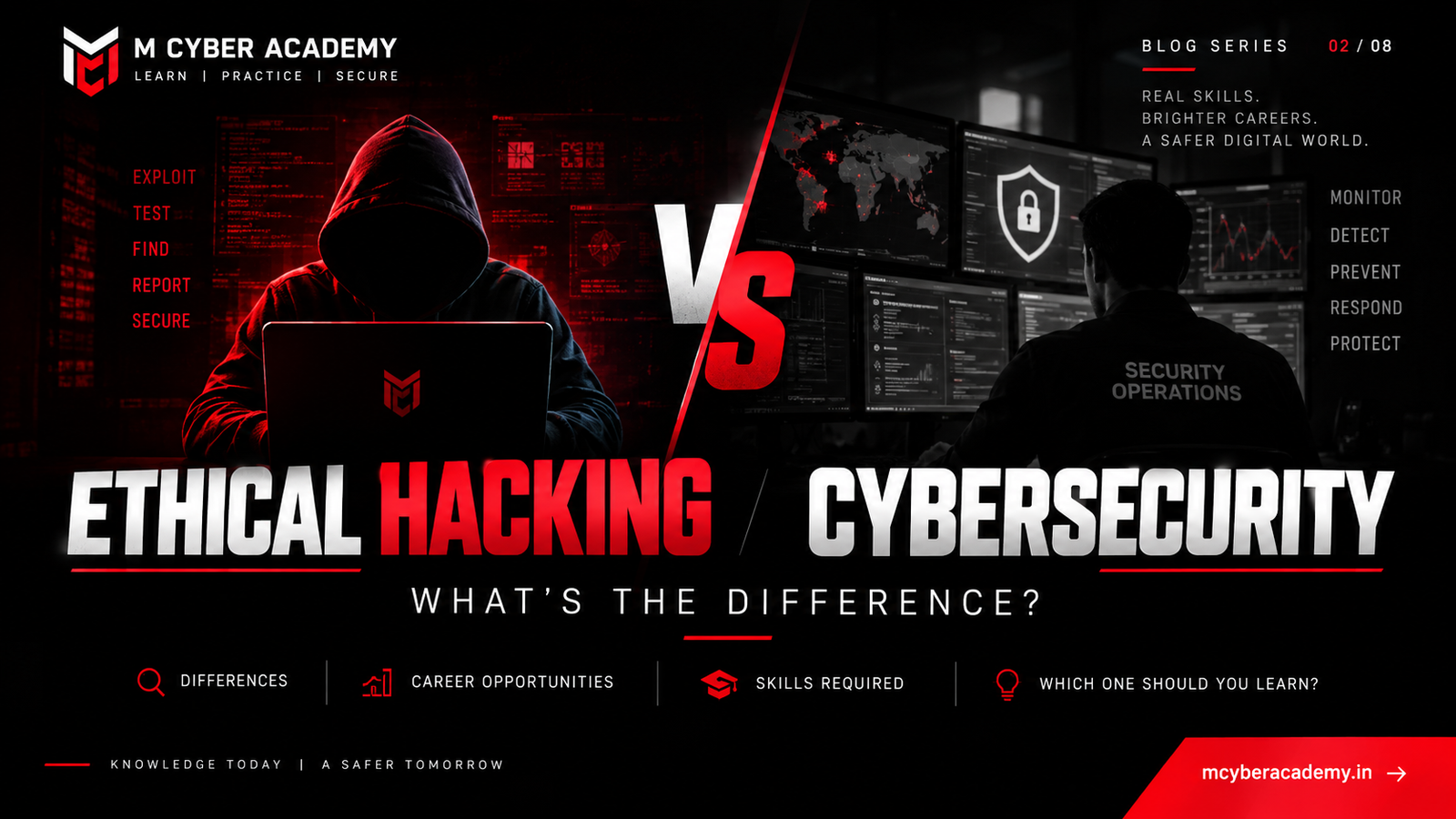
Ethical Hacking vs Cybersecurity:
What’s the Difference?
Ethical hacking and cybersecurity are closely connected, but they are
not the same thing. Understand the difference, required skills,
career opportunities, and where ethical hacking fits into the
larger world of cybersecurity.
If you are planning a career in cybersecurity, you have probably come
across terms like ethical hacking, penetration testing,
cybersecurity, SOC, and information security. They may sound similar,
but each has a different role. The simplest way to understand the
relationship is this:
ethical hacking is a specialized area within the broader field of cybersecurity.
What Is Cybersecurity?
Cybersecurity is the practice of protecting computers,
networks, applications, systems, devices, and data from unauthorized
access, attacks, damage, and disruption.
A cybersecurity professional may work on preventing attacks, monitoring
suspicious activity, identifying vulnerabilities, responding to
security incidents, protecting sensitive information, and improving
an organization’s overall security posture.
This makes cybersecurity a broad field. It can include
network security, application security, cloud security,
endpoint security, identity and access management, vulnerability
management, digital forensics, incident response and several
other areas.
Cybersecurity focuses on keeping digital systems, information and
infrastructure secure before, during and after a security incident.
What Is Ethical Hacking?
Ethical hacking is the authorized process of testing
computer systems, networks, websites and applications to discover
security weaknesses before malicious attackers can exploit them.
Ethical hackers work with permission from the organization. Their goal
is not to steal information or damage a system. Instead, they think like
an attacker, test security controls, identify vulnerabilities and
provide information that can help the organization fix those weaknesses.
Activities such as penetration testing, vulnerability
assessment, web application security testing, network security testing
and controlled attack simulations can fall under ethical hacking.
Ethical hackers use an attacker’s mindset with
authorized access to help organizations discover
and fix security weaknesses.
Ethical Hacking vs Cybersecurity
The biggest difference is the scope and objective.
Ethical hacking generally focuses on finding and demonstrating
vulnerabilities, while cybersecurity covers the wider process of
protecting systems, detecting threats and responding to security
incidents.
| Area | Ethical Hacking | Cybersecurity |
|---|---|---|
| Primary Focus | Finding and testing security vulnerabilities | Protecting systems, networks, applications and data |
| Scope | More specialized | Broader security discipline |
| Approach | Often uses an attacker’s perspective | Includes prevention, detection, protection and response |
| Common Work | Penetration testing and vulnerability assessment | Monitoring, security management, incident response and risk reduction |
| Goal | Discover weaknesses before attackers do | Reduce security risks and protect digital assets |
| Career Examples | Ethical Hacker, Penetration Tester | SOC Analyst, Security Analyst, Security Engineer |
Ethical hacking is part of cybersecurity.
Cybersecurity is the larger field, while ethical hacking focuses
heavily on authorized security testing and vulnerability discovery.
Skills, Careers & Opportunities
Whether you choose ethical hacking or another cybersecurity
specialization, a strong technical foundation is important.
Understanding how networks, operating systems, applications and
security controls work will help you build practical cybersecurity
skills.
Networking
Linux
Python
Web Security
Vulnerability Assessment
Penetration Testing
Security Tools
Problem Solving
These skills can lead to different career paths depending on your
interests and specialization. Some professionals focus on offensive
security and penetration testing, while others work in security
monitoring, incident response, vulnerability management or security
engineering.
Ethical Hacker
Tests systems and applications with authorization to identify
security weaknesses.
Penetration Tester
Performs controlled security tests to understand how vulnerabilities
could potentially be exploited.
SOC Analyst
Monitors security events and helps identify and respond to potential
threats.
Security Analyst
Works across security operations, risk reduction, monitoring and
protection of organizational systems.
Which One Should You Learn?
There is no single answer for everyone. Your choice should depend on
the type of cybersecurity work you want to do.
If you enjoy finding vulnerabilities, understanding how attacks work,
testing websites and networks, and thinking from an attacker’s
perspective, ethical hacking may be an interesting
specialization for you.
If you are interested in protecting systems, monitoring threats,
investigating incidents, managing security controls or working across
multiple areas of information security, a broader
cybersecurity learning path may suit you better.
Build your foundation first with networking, Linux, operating systems
and security concepts. From there, you can explore ethical hacking,
penetration testing, SOC operations, digital forensics or other
cybersecurity specializations.
Frequently Asked Questions
Is ethical hacking part of cybersecurity?
cybersecurity field. It focuses on authorized security testing,
vulnerability discovery and controlled attack simulations.
What is the difference between an ethical hacker and a cybersecurity professional?
through authorized security testing, while cybersecurity professionals
can work across a much wider range of security activities, including
prevention, monitoring, incident response and security management.
Can I learn ethical hacking without coding?
knowledge. However, learning scripting and programming languages such
as Python can become increasingly useful as you move toward more
advanced security work.
Which should I learn first, ethical hacking or cybersecurity?
operating systems and basic security concepts. Once your foundation
is strong, you can specialize in ethical hacking or another area of
cybersecurity.
Can ethical hacking become a cybersecurity career?
penetration testing, vulnerability assessment and offensive security,
while also providing a strong foundation for broader cybersecurity
roles.
Build Your Cybersecurity Skills
Want to move beyond theory and learn cybersecurity through practical
training? Explore hands-on learning in ethical hacking, cybersecurity,
penetration testing and other security domains with
M Cyber Academy.