


- December 11, 2025
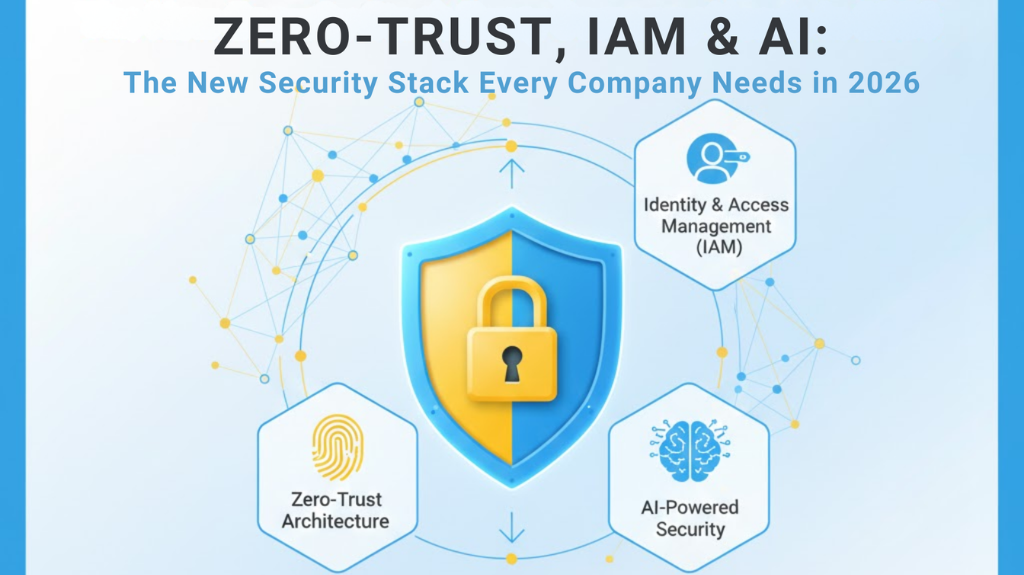
The cybersecurity landscape is changing faster than ever. As we move from 2025 into 2026, traditional security models based on firewalls and perimeter defense are no longer enough. Cloud computing, remote work, AI-powered cyber attacks, and exploding digital identities have completely reshaped how organizations must protect their systems. In this new era, a powerful trio has emerged as the backbone of modern cybersecurity: Zero-Trust Architecture, Identity and Access Management (IAM), and Artificial Intelligence (AI). Together, these three form the new security stack every company needs in 2026 to survive and grow securely.
Why Traditional Security Is Failing in 2026
Earlier, organizations relied heavily on the idea of a “trusted internal network.” Once inside the network, users, systems, and devices were often given broad access. But today, this approach is dangerously outdated. Employees work from home, data lives in the cloud, applications run on multiple platforms, and attackers use AI to bypass outdated defenses.
Cyber threats such as ransomware, AI-driven phishing, deepfake fraud, and credential theft are rising sharply. A single compromised password can expose entire organizations. This reality has forced companies to abandon old security models and adopt a more dynamic, identity-focused, and intelligent approach to cyber defense.
Zero-Trust: Never Trust, Always Verify
Zero-Trust is no longer a buzzword—it is the foundation of modern cybersecurity in 2026. The principle is simple but powerful: never trust any user, device, or system by default, even if it is inside your network. Every access request must be verified continuously.
Under Zero-Trust, access decisions are based on identity, device health, location, behavior, and risk level. For example, an employee logging in from a new device or unusual location may be asked for additional authentication or blocked altogether. This model drastically reduces the chances of lateral movement by attackers inside the network.
Zero-Trust also limits user permissions to only what is strictly necessary. This means that even if one account is compromised, the attacker cannot freely access everything. In 2026, Zero-Trust is becoming the default approach for enterprises, governments, and even small businesses moving to the cloud.
IAM: The Control Center of Digital Identity
As organizations grow digitally, the number of users, devices, and applications multiplies rapidly. This is where Identity and Access Management (IAM) becomes critical. IAM ensures that the right person gets the right level of access to the right system at the right time.
Modern IAM in 2026 goes far beyond just usernames and passwords. It includes multi-factor authentication (MFA), biometric verification, single sign-on (SSO), privileged access management (PAM), and real-time access analytics. Every login, permission change, and access request is tracked and analyzed.
IAM also plays a major role in compliance with data protection laws and cybersecurity regulations. Whether it is protecting customer data, controlling employee access, or securing third-party vendors, IAM acts as the central nervous system of enterprise security.
Without strong IAM, Zero-Trust cannot work effectively. Identity is now the new perimeter, and IAM is the gatekeeper.
AI: The Brain Behind Smart Cyber Defense
If Zero-Trust is the strategy and IAM is the control system, then Artificial Intelligence is the brain that powers modern cybersecurity in 2026. AI enables real-time threat detection, automated response, and predictive security.
Traditional security tools depend heavily on predefined rules and signatures. But modern cyber attacks change too quickly for manual detection. AI analyzes massive volumes of data from networks, users, devices, and applications to identify abnormal behavior instantly.
AI helps detect:
Advanced phishing attacks
Insider threats
Zero-day vulnerabilities
Credential misuse
Malware and ransomware behaviors
More importantly, AI doesn’t just detect threats—it responds automatically. It can isolate devices, block suspicious accounts, trigger alerts, and even roll back attacks in seconds. This level of speed and precision is impossible without automation.
Why Zero-Trust, IAM & AI Work Best Together
Individually, Zero-Trust, IAM, and AI are powerful. But together, they create a fully integrated, intelligent security ecosystem. Zero-Trust defines how access is granted, IAM controls who gets access, and AI continuously monitors and protects the entire system.
For example, if AI detects unusual login behavior, IAM can enforce additional verification, while Zero-Trust policies may limit the user’s access instantly. This layered approach drastically reduces breach impact and response time.
In 2026, cybersecurity is no longer about stopping attackers at the gate—it is about continuously validating every action inside the system. This is only possible when Zero-Trust, IAM, and AI work as one unified security stack.
Business Benefits of the New Security Stack
Organizations adopting this modern security trio gain more than just protection. They achieve stronger business continuity, improved customer trust, and regulatory compliance. Automated security operations reduce response times from hours to seconds. Cloud adoption becomes safer. Remote work becomes more secure. And digital transformation becomes sustainable.
From startups to multinational corporations, the message is clear: security must be identity-driven, AI-powered, and Zero-Trust enforced.
Career Opportunities in Zero-Trust, IAM & AI Security
The rise of this new security stack is also creating massive career opportunities. Roles such as Zero-Trust Architect, IAM Engineer, SOC Analyst, Cloud Security Engineer, and AI Security Specialist are in extremely high demand. These skills are now considered future-proof and premium in the cybersecurity job market.
For students and professionals entering cybersecurity in 2026, learning these technologies is not optional—it is essential for long-term success.
Final Thoughts
At MCyberAcademy, our advanced training in Zero-Trust Security, Identity and Access Management (IAM), and AI-driven cybersecurity is designed to equip professionals with real-world, hands-on expertise. Our industry-aligned curriculum helps learners not only understand modern security frameworks but also apply them confidently in real organizational environments. By mastering these next-generation security technologies, cybersecurity professionals can ensure that digital systems are not only innovative and high-performing but also secure, ethical, and fully compliant. With MCyberAcademy, you don’t just prepare for today—you future-proof your cybersecurity career for 2026 and beyond.